Higher Social Class Predicts Increased Unethical Behavior -- National Academy Of Sciences
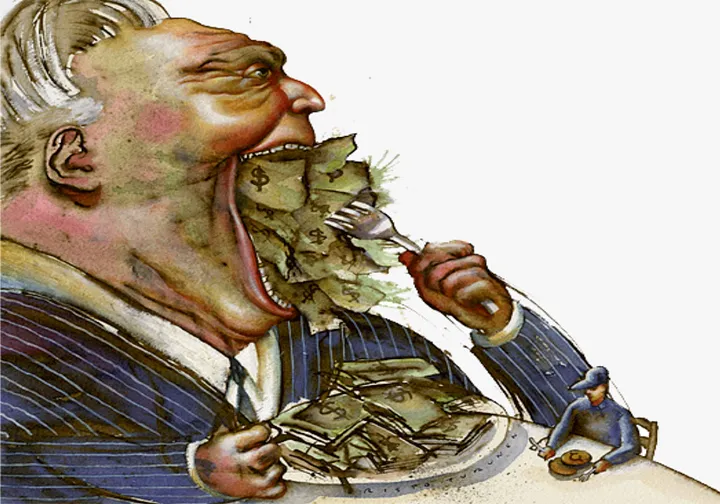 Image courtesy of 2020epmellon.wordpress.com
Research Article -- Psychological and Cognitive Sciences
Proceedings of the National Academy of Sciences of the United States of America
Feb. 27, 2012
ABSTRACT
Seven studies using experimental and naturalistic methods reveal that upper-class individuals behave more unethically than lower-class individuals.
In studies 1 and 2, upper-class individuals were more likely to break the law while driving relative to lower-class individuals.
In follow-up laboratory studies, upper-class individuals were more likely to exhibit unethical decision-making tendencies (study 3), take valued goods from others (study 4), lie in a negotiation (study 5), cheat to increase their chances of winning a prize (study 6), and endorse unethical behavior at work (study 7) than were lower-class individuals.
Mediator and moderator data demonstrated that upper-class individuals’ unethical tendencies are accounted for, in part, by their more favorable attitudes toward greed.
- CategoriesEdited | Front Page Stories | All Content | Culture | Economy | Labor | Crime | North America | News | Analysis | News -- WNT Selected
- Date rangeFriday, March 15, 2024
- Last modifiedFriday, March 15, 2024
