Putin and the Geopolitics of the New Cold War (William Engdahl)
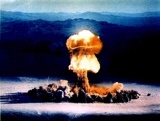
Since the end of the Cold War in 1989, it's now clear that the US Government has never for a moment stopped its pursuit of Nuclear Primacy. For Washington and the US elites, the Cold War never ended. They just forgot to tell us all.
Or, what happens when Cowboys don't shoot straight like they used to...
F. William Engdahl -- www.engdahl.oilgeopolitics.net
Feb. 19, 2007 -- The frank words of Russia's President Vladimir Putin to the assembled participants of the annual Munich Wehrkunde security conference have unleashed a storm of self-righteous protest from Western media and politicians. A visitor from another planet might have the impression that the Russian President had abruptly decided to launch a provocative confrontation policy with the West reminiscent of the 1943-1991 Cold War.
However, the details of the developments in NATO and the United States military policies since 1991 are anything but 'déjà vu all over again', to paraphrase the legendary New York Yankees catcher, Yogi Berra.
This time round we are already deep in a New Cold War whose stakes are literally the future of life on this planet. The debacle in Iraq, or the prospect of a U.S. tactical nuclear pre-emptive strike against Iran are ghastly enough. In comparison to what is at play in the U.S. global military buildup against its most formidable remaining global rival, Russia, they loom relatively small. The US military policies since the end of the Soviet Union and emergence of the Republic of Russia in 1991 are in need of close examination in this context. Only then do Putin's frank remarks on Feb. 10 at the Munich Conference on Security make sense.
Because of the misleading accounts of most of Putin's remarks in most western media, it's worth reading in full in English (go to www.securityconference.de for official English translation).
Putin spoke in general terms of Washington's vision of a 'unipolar' world, with 'one center of authority, one center of force, one center of decision-making, calling it a 'world in which there is one master, one sovereign. And at the end of the day this is pernicious not only for all those within this system, but also for the sovereign itself because it destroys itself from within.'
Then the Russian President got to the heart of the matter: 'Today we are witnessing an almost uncontained hyper use of force -- military force -- in international relations, force that is plunging the world into an abyss of permanent conflicts. As a result we do not have sufficient strength to find a comprehensive solution to any one of these conflicts. Finding a political settlement also becomes impossible.'
Putin continued, 'We are seeing a greater and greater disdain for the basic principles of international law. And independent legal norms are, as a matter of fact, coming increasingly closer to one state's legal system. One state and, of course, first and foremost the United States, has overstepped its national borders in every way. This is visible in the economic, political, cultural and educational policies it imposes on other nations. Well, who likes this? Who is happy about this?'
These direct words begin to touch on what Mr Putin is concerned about in U.S. foreign and military policy since the end of the Cold War some 16 or so years back. But it is further in the text that he gets explicit about what military policies he is reacting to. Here is where the speech is worth clarification. Putin warns of the destabilizing effect of 'space weapons.' -- 'it is impossible to sanction the appearance of new, destabilising high-tech weapons ... a new area of confrontation, especially in outer space. Star wars is no longer a fantasy -- it is a reality.... In Russia's opinion, the militarization of outer space could have unpredictable consequences for the international community, and provoke nothing less than the beginning of a nuclear (arms race-f.w.e.) era.'
He then declares, 'Plans to expand certain elements of the anti-missile defence system to Europe cannot help but disturb us. Who needs the next step of what would be, in this case, an inevitable arms race?'
What does he refer to here? Few are aware that while claiming it is doing so to protect itself against the risk of 'rogue state' nuclear missile attack from the likes of North Korea or perhaps one day Iran, the US recently announced it is building massive anti-missile defense installations in Poland and the Czech Republic.
Poland? Missile defense? What's this all about?\
more
- Categories
- Date rangeTuesday, February 20, 2007
- Last modifiedWednesday, November 06, 2013
