Photon Entanglement May Explain The Rapid Brain Signals Of Consciousness
David Appell -- Phys.org
Aug. 16, 2024
Understanding the nature of consciousness is one of the hardest problems in science. Some scientists have suggested that quantum mechanics, and in particular quantum entanglement, is the key to unraveling the phenomenon.
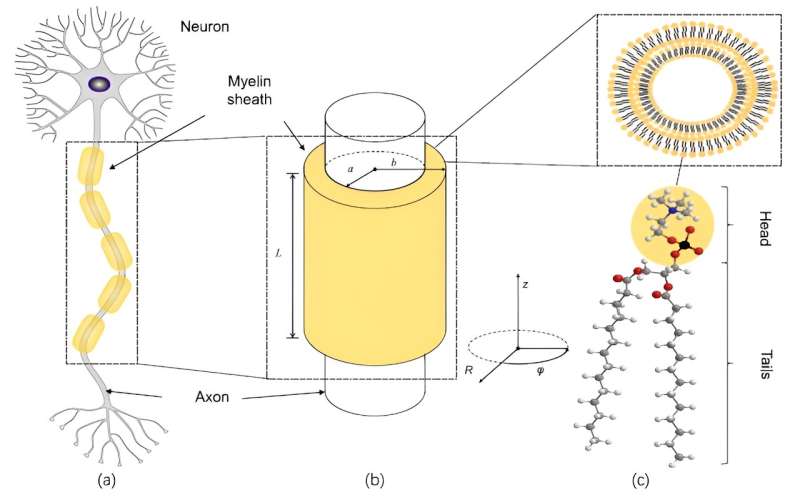
Now, a research group in China has shown that many entangled photons can be generated inside the myelin sheath that covers nerve fibers. It could explain the rapid communication between neurons, which so far has been thought to be below the speed of sound, too slow to explain how the neural synchronization occurs.
The paper is published in the journal Physical Review E.
"If the power of evolution was looking for handy action over a distance, quantum entanglement would be [an] ideal candidate for this role," said Yong-Cong Chen in a statement to Phys.org. Chen is a professor at the Shanghai Center for Quantitative Life Sciences and Physics Department at Shanghai University.
(more)
- Categories
- Date rangeSunday, August 18, 2024
- Last modifiedSunday, August 18, 2024
