Introducing Karl Polanyi (Adrian Pabst)
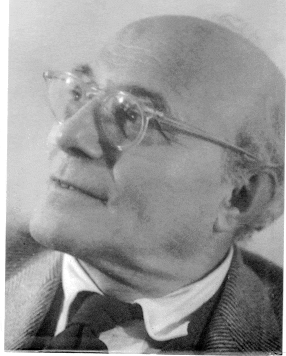
Step aside, Keynes: the only economist to grasp the real limitations of capitalism and socialism was Hungarian
Nov. 9, 2008 (Guardian) --When world leaders gather in Washington, D.C., Nov. 15 to coordinate action after the financial meltdown, the shadow of John Maynard Keynes will loom large. The architect of the Bretton Woods conference that gave rise to the post-1945 international economic system, Keynes' ideas have also inspired the recent British and EU responses to the deepening recession.{xtypo_quote_right} Far from romanticising older, simpler societies and economies, Polanyi, with extraordinary prescience, warned that financial crises would recur because markets are not self-regulating– they require political direction. {/xtypo_quote_right}
Unfortunately, Keynesian reforms of the Bretton Woods institutions (notably the IMF and the World Bank), or Keynesian policies like lower interest rates and increased spending, won't change the nature of global finance which got us into the current mess. To stabilise the world economy and to generate prosperity for all, we need a different relationship between government and the marketplace. (More about that later.)
New international financial regulations will not eliminate the sort of credit-fuelled and debt-leveraged speculation that brought the entire system to the brink of collapse. That problem is the status of money in capitalism. As the Archbishop of Canterbury, Rowan Williams, recently reminded us, since Marx we know that capitalism treats money as if it had a life of its own. In other words, capitalism views capital as a reality in its own right, with power and agency. And in order to enhance the power of money, the capitalist economy turns human labour into a commodity whose value is determined exclusively by its market price.
The trouble is that the Marxist critique of capitalism does not go far enough. Left to itself, the capitalist economy also views land and social relations as commodities that are priced by markets. As such, the free market violates a universal ethical principle that has governed virtually all cultures in the past – nature and human life have almost always been recognised as having a sacred dimension. In subordinating society and the environment to the market, capitalism does not just disrupt traditional cultures, as Marx pointed out. It also causes widespread social disintegration and ecological devastation.
more
Read More: The Guardian
Karl Polanyi from Wikipedia
Karl Polanyi from The New School for Social Research
Concordia University's Karl Polanyi Institute of Political Economy
- Categories
- Date rangeSunday, November 09, 2008
- Last modifiedWednesday, November 06, 2013
