Ending Plutocracy: A 12-Step Program (Sarah Anderson, Sam Pizzigatti)
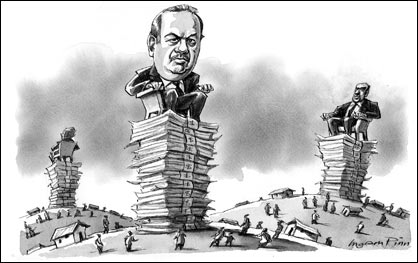
Our forebears struggled to survive in a world dominated by the superrich. Now it's our turn.
America's first Gilded Age didn't merely end. Progressives had to fight to end it. Our forebears did battle, decade after decade, for proposals that dared to "soak the rich."
How quaint that phrase now seems. Progressives today do talk about making the superrich pay their "fair tax share"; but we no longer dare imagine an America without the superrich. We have become addicted to a politics that ignores the power of the fabulously wealthy to define--and distort--our nation's political agenda.
{xtypo_quote_right} Can such an offensive succeed? Why not? Our forebears faced a plutocracy more entrenched than ours. They beat that plutocracy back. {/xtypo_quote_right}
How can we end this addiction? In the twelve-step spirit of dependency-busters everywhere, we offer a dozen policy approaches that can help slice America's superwealthy down to democratic size. To help us rebuild our plutocracy-busting self-confidence, we begin with the somewhat more winnable.
Step 1: Admit we are powerless unless we learn more about how concentrated our nation's wealth has become.
Back in 1907 Joseph Pulitzer ended his publishing career with a farewell that urged readers to forever beware "predatory plutocracy." He had started that career, years earlier, exposing wealthy tax
dodgers. Disclosure has been a prime weapon in the progressive arsenal ever since.
- Require government contractors to reveal how much their executives make. The Securities and Exchange Commission currently requires publicly traded companies to reveal how much their top five executives are making. But privately held companies face no such mandate, and the CEO of private security giant Blackwater last fall refused to divulge how much he has personally pocketed from his company's contracts in Iraq. One bill now before Congress, the Government Contractor Accountability Act, would force companies like Blackwater to disclose their top executive pay.
- Require corporations to report CEO-worker pay gaps. CEOs now take in, as a share of corporate earnings, twice as much as they walked off with just a decade ago. The labor share of national income, meanwhile, has shrunk to record lows. Which companies are shoving the most cash up the corporate flow-chart? If corporations were required to annually document the gap between their highest- and lowest-paid employees, we would know.
- Require the super-wealthy to make their tax returns public. In 1934 early New Dealers enacted legislation that made the incomes of wealthy people and the taxes they pay a matter of public record. But the super-rich quickly launched a fervid PR campaign that attacked the new statute as an open invitation to kidnappers. In an America still reeling from the infamous Lindbergh baby snatching, that claim gave lawmakers a convenient cover for repealing this tax sunshine mandate. In 2005 America's top-earning 400 paid a paltry 18.2 percent of their incomes in federal tax. It's time to let the sunshine back in.
Step 2: Trust in a power greater than CEOs and their buddies.
America's top 0.01 percent of taxpayers have seen their collective income quadruple, after inflation, over the past two decades. Corporate executives account for about a fifth of that income. How have
CEOs engineered their awesome take-homes? They essentially pay
themselves. They sit on each other's corporate boards and rubber-stamp
executive pay plans that come from consultants who know where their
bread's buttered. Democratizing corporate governance could help end
this enabling.
- Give shareholders a "say on pay." The House of Representatives voted last year to give shareholders the right to vote on executive compensation. But these votes would be advisory only, and such nonbinding votes elsewhere - in Britain, for instance - haven't done much to break executive pay spirals. Still, the prospect of shareholder "no" votes could dampen the willingness of corporate boards to keep signing blank checks. The Senate has so far stalled on "say on pay."
- End Kremlin-style corporate board elections. To really rein in CEO pay, shareholders need more than an advisory say on pay. They need a say on who sits on corporate boards. Corporate board elections currently sport all the democratic trimmings of Leonid Brezhnev's Supreme Soviet, complete with fixed slates. In 2003 the SEC proposed giving shareholders a halfway meaningful right to vote for alternative candidates. But fierce opposition from the Business Roundtable, the nation's leading CEO club, nyeted this attempt at corporate perestroika.
- Give all stakeholders a real corporate voice. Shareholders, suitably empowered, could help check executive excess. But workers and their communities have just as much stake in CEO pay decisions as shareholders because over-the-top pay plans give CEOs an incentive to pump up short-term bottom lines at the expense of long-haul enterprise success. Mandating worker and community representation on corporate boards could institutionalize a voice for all corporate stakeholders.
more
Read More: Institute for Policy Research
- Categories
- Date rangeSaturday, July 19, 2008
- Last modifiedWednesday, November 06, 2013
